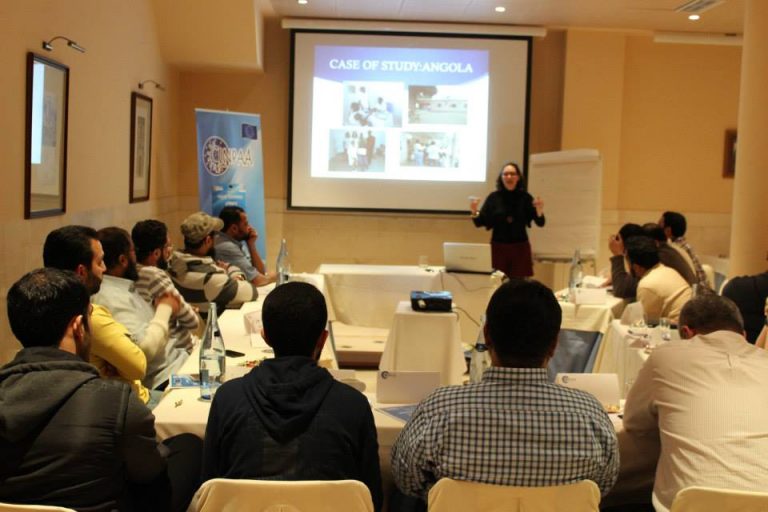
A programme focused on developing leadership and decision-making skills in humanitarian environments characterised by complexity, pressure, and multiple stakeholders.
Programme objectives
Developing participants’ skills, knowledge, values and professional approaches in:
Develop leadership under conditions of uncertainty.
Improve decision quality under pressure.
Strengthen clarity of roles and responsibilities.
Support coordination between leadership and operations.
Compare humanitarian decision options against impact, risk and available resources.
Target audience
Humanitarian executives
Humanitarian programme and operations managers
Team leaders working in crises
Programme topics
1Day 1
Executive leadership in crises
Authority boundaries for executives during humanitarian crises
Accountability for executive decisions taken with incomplete information
Leading under uncertainty: what changes for senior managers
Clarifying roles and responsibilities between leadership and operations
Case study: analysing how authority was exercised in a complex humanitarian crisis
Day output: authority and accountability map for a crisis team
2Day 2
Decision-making under pressure
Separating verified facts from assumptions in a crisis briefing
Comparing decision options under time pressure with simple criteria
Common cognitive biases that distort decisions in emergencies
Judging options against impact, risk and the resources available
Workshop: structured comparison of three response options for a crisis case
Day output: decision options matrix with impact, risk and resources
3Day 3
Priority management in complex environments
Using an urgency and impact matrix to rank competing demands
Reallocating staff and funds as operating conditions change
Protecting critical programmes when budgets or access are reduced
Recording reprioritisation decisions so teams understand the reasons
Workshop: reprioritising a portfolio after a sudden loss of access and funding
Day output: revised priority list with documented rationale
4Day 4
Multi-stakeholder coordination and negotiation
Analysing conflicting stakeholder interests in humanitarian settings
Negotiating shared priorities with donors, authorities and partners
Supporting coordination between leadership and operational teams
Preparing negotiation positions and acceptable fall-back options
Case study: negotiation on access and priorities among several humanitarian actors
Day output: negotiation brief with positions and fall-back options
5Day 5
Leadership communication in complex environments
Writing a concise situation brief for senior decision-makers
Communicating decisions and instructions clearly to field teams
Explaining difficult decisions to staff, partners and communities
Keeping communication consistent as the situation changes over time
Workshop: drafting a situation brief and a team instruction from a live scenario
Day output: one-page situation brief and decision message
Certificates
On successful completion, participants receive a certificate issued by CINPAA, a training institute officially registered in the European Union, Spain and the United Kingdom.
Our programmes are delivered within academic and professional partnerships, cooperation agreements and memoranda of understanding with a number of academic and professional institutions, including:
Camilo José Cela University – Spain
ISDE – Law & Business School – International
Professional Development Institute – United Kingdom
These partnerships aim to exchange expertise, develop training content and raise programme quality in line with international best practice.
Available dates and cities
Dates and destinations are subject to confirmation after your request is reviewed.