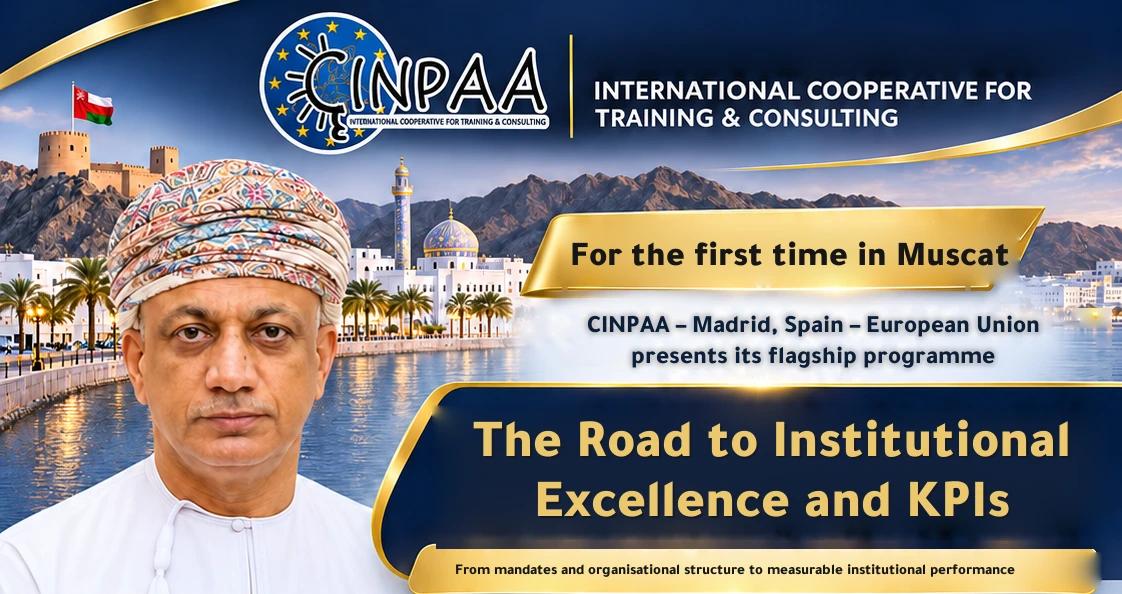
Banner of the CINPAA programme “The Road to Institutional Excellence and KPIs”, CINPAA – International Cooperative for Training & Consulting: for the first time in Muscat, with Dr. Rashid bin Juma bin Mohammed Al Wahaibi, from mandates and organisational structure to measurable institutional performance.

The Road to Institutional Excellence and KPIs — from mandates and organisational structure to measurable institutional performance

VenueMuscatSultanate of Oman
Dates17–21 January 2027Sunday to Thursday
Duration and language5 in-person daysDelivered in Arabic
FeeOMR 125per participant
Share the programme
Why this programme?

From approved mandatesto measurable institutional performance

The programme sets out practical steps for a government entity to move to institutional work. It starts from the founding decree, the mandates and the approved organisational structure, and builds the “single job family”, in line with Oman Vision 2040 and the requirements of institutional and individual excellence. It prepares the entity for internal and external assessment, and for digital transformation and governance.

Three elements that drive institutional performance

  • The job

    Defining core and support jobs and their role in fulfilling the entity’s mandates.

  • The employee

    Aligning competencies, career paths and training paths with the requirements of the job.

  • The work environment

    Creating an internal work environment that supports integration between departments and performance measurement.

What will your organisation achieve?

Key learningoutcomes

Aligning institutional performance with Oman Vision 2040

Institutional and organisational alignment

Reading the mandates and the approved structure, defining the single job family, and classifying core and support families.

HR development, management and capacity building

Developing human resources and job families

Horizontal, vertical, lateral and training paths, and the four HR strategies.

Designing and measuring key performance indicators (KPIs)

Designing and monitoring KPIs

Measuring individual and overall performance, and writing indicators that can be applied and monitored.

Achieving institutional and operational excellence

Institutional excellence and performance improvement

Assessing institutional work as integrated families, prioritising projects and addressing challenges.

Programme objectives

  1. 01

    Define the single job family according to the decree, the mandates and the approved organisational structure.

  2. 02

    Classify broad, specialised and sub job families, and identify the core and support families and the role of each in the entity’s vision, mission and values.

  3. 03

    Define the type of job, the type of employee and the type of internal work environment in each job family.

  4. 04

    Learn the organisational guides that steer institutional work.

  5. 05

    Learn the four HR strategies and how they relate to institutional work.

  6. 06

    Explore senior-management and HR challenges and turn them into solutions and incentives.

  7. 07

    Measure individual and overall performance and design KPIs that can be applied and monitored.

Who it is for and how it is delivered

Target audienceand delivery method

Target audience

  • Government leaders
  • HR directors
  • Institutional performance departments
  • Strategic planning teams
  • Organisational development specialists

in government and semi-government entities.

Programme method

  • Orientation and review of mandates and structure
  • Management cases from government practice
  • Practical applications and examples
  • Team work
  • A proposed model for institutional work
Daily agenda

Five daysfrom structure to indicators

Day 10117 January

Organisational structures and job families

  • Introduction and orientation; review of the entity’s mandates and approved organisational structure.
  • Defining the single job family and classifying broad, specialised and sub families.
  • The relationship matrix between jobs, employees and internal work environments.
  • Job identity: the flexible job description card and the guiding organisational manuals.
Day 20218 January

Human resources and career development

  • Guides to the horizontal, vertical, lateral and training paths for members of the family.
  • The procedures manual for the job family.
  • Training-needs analysis tools (57 tools) and how they link to training paths.
  • The relationship between an employee’s age and productivity across the stages of the career line.
Day 30319 January

HR strategies and institutional improvement

  • The four HR strategies: recruitment and appointment; development; investment and retention; retirement and beyond.
  • A full survey of HR challenges within the organisational structure, and finding solutions.
  • The incentive and recognition system for the job, the employee and the work environment.
  • Applied case studies from government practice.
Day 40420 January

Digital transformation and practical KPIs

  • Automating the institutional work system: inputs, processes, outputs and feedback.
  • A proposed model for automating the single job family (the “e-family”).
  • A practical workshop on writing KPIs linked to mandates and job families.
  • The indicator monitoring card and its data sources.
Day 50521 January

Performance assessment and institutional action plans

  • Measuring individual and overall performance within the single job family.
  • Assessing institutional work as job families, not isolated islands.
  • Prioritising projects, key achievements and HR development projects.
  • Preparing an institutional action plan for each team and presenting it at the close.
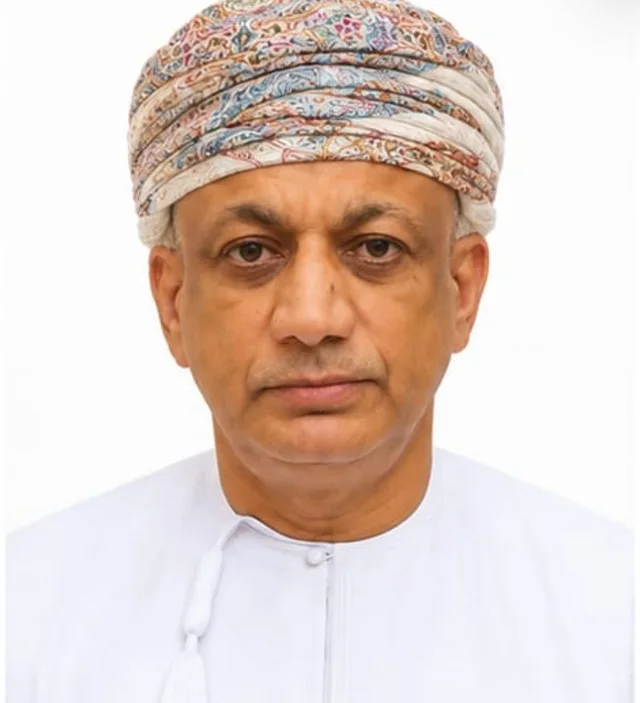
Photo of Dr. Rashid bin Juma bin Mohammed Al Wahaibi
The trainer

Dr. Rashid bin Juma bin Mohammed Al WahaibiHuman resources and management development expert

32 years of practical experience in human resources, mostly delivering strategic HR development projects in the government sector of the Sultanate of Oman, as well as programmes and courses for the Omani private sector. He is the author of this programme’s methodology.

  • PhD in Business Administration (Human Resources), Faculty of Commerce, Ain Shams University.
  • Higher Diploma in Organisation and Work Methods, and a Bachelor’s in Business Administration.
  • Career-path consultant, and adviser to centres and institutes in management consulting, training and HR development.
  • Head and trainer of teams preparing job description cards linked to horizontal and vertical paths and the job relationship matrix.
Certificate and fee

Certificateand participation fee

A European certificate accredited in the European Union, issued by CINPAA and its academic partners. Fee: OMR 125.
  • 5 in-person training days in Muscat
  • Delivered in Arabic, with practical applications
  • Certificate of completion issued by CINPAA – Madrid
  • Priority nomination for advanced training tracks
Participation fee
125OMR

Fee: OMR 125 per participant

Register your interest
Our academic partners
Universidad Camilo José Cela
Camilo José Cela University – Madrid
ISDE Law Business School
ISDE Higher Institute of Law and Business – Spain
Accreditation
Professional Development Institute
International track

From Muscatto CINPAA advanced tracks

Priority nomination for advanced tracks in Istanbul, Dubai, Kuala Lumpur and Madrid

Graduates receive priority nomination for the advanced training tracks that CINPAA later organises in Istanbul, Dubai, Kuala Lumpur or Madrid, with exclusive registration benefits within the CINPAA alumni network, under the conditions of future programmes.

View of Istanbul
Istanbul
View of Dubai
Dubai
View of Kuala Lumpur and the Petronas Towers
Kuala Lumpur
A landmark in Madrid
Madrid
CINPAA | CINPAA

International Cooperativefor Training & Consulting - European Union

Founded in Madrid in 2010 and registered in Spain and the United Kingdom, CINPAA works in competency development, training, consulting and international cooperation. It serves government and semi-government entities, companies, universities, educational institutions and non-profit organisations.

Cities where we deliver our programmes · and Muscat in January 2027

MoscowDubaiDar es SalaamSouth AfricaKuala LumpurBangkokTokyoMiamiMuscat · January 2027

and other cities across Europe, Asia, Africa and the Americas on request.

Official poster

Programme posterto share and print

Share the poster with your colleagues and team, or open it full size.

Open the original file
Official programme poster
Official programme poster, full size
Registration and inquiries

Register your interestin the Muscat 2027 programme

Fill in the form, or contact us directly:

Frequently asked questions

Frequently askedquestions

When does the programme take place?

From Sunday 17 to Thursday 21 January 2027: 5 in-person training days.

Where is it held?

In Muscat, Sultanate of Oman. Registered participants are told the exact venue.

Who is it for?

Government leaders, HR directors, institutional performance departments, strategic planning teams and organisational development specialists.

What language is it delivered in?

The programme is delivered in Arabic.

What is the fee?

Fee: OMR 125 per participant.

What certificate do participants receive?

A certificate of completion issued by CINPAA – International Cooperative for Training & Consulting, Madrid – Spain, for participants who meet the programme requirements.

How do I register?

Send an inquiry through the form on this page, or email us at info@cinpaa.org, and the CINPAA team will contact you with the registration steps.

Share the programme