
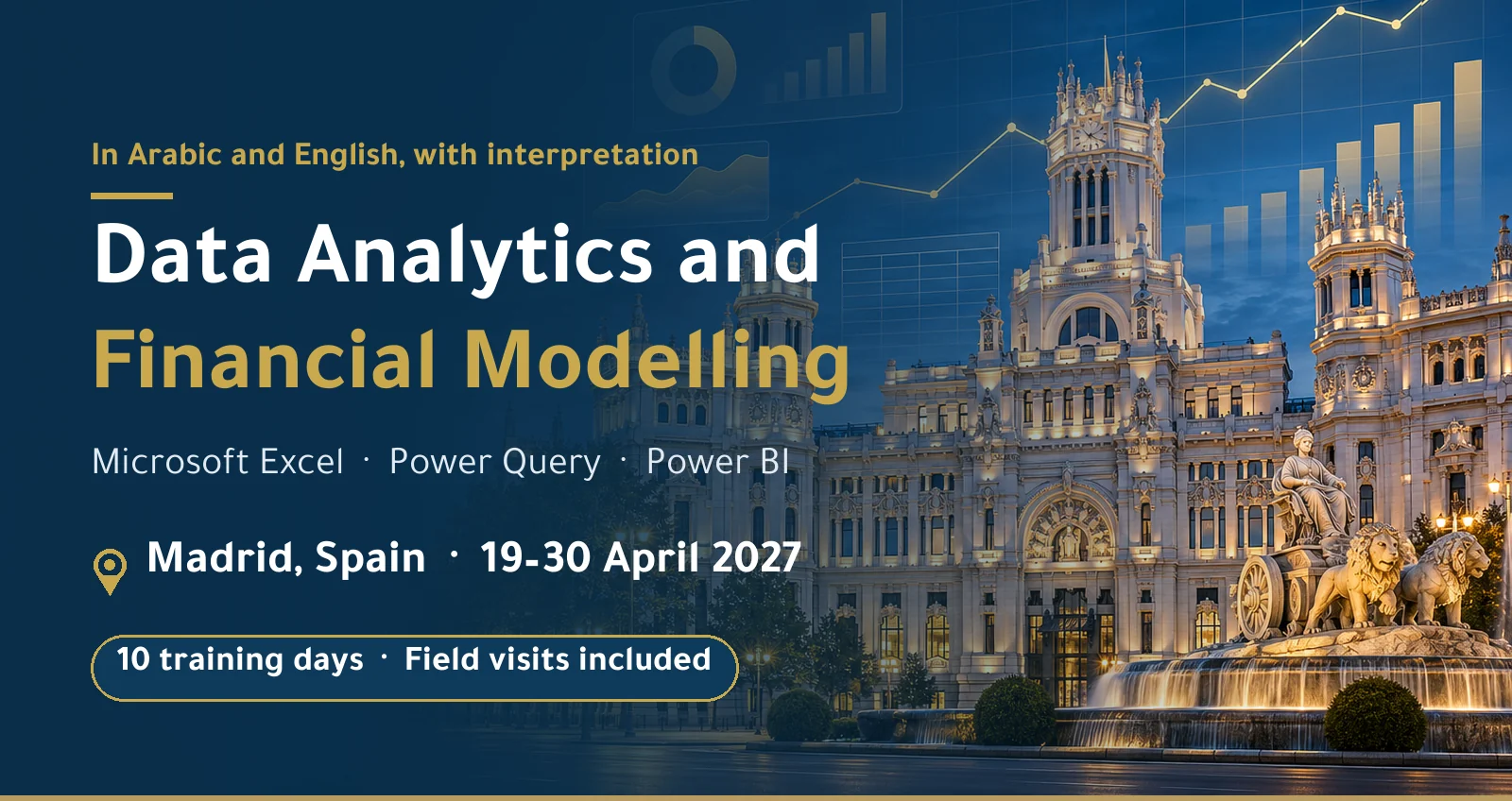
Banner of the CINPAA programme Data Analytics and Financial Modelling: Microsoft Excel, Power Query and Power BI, Madrid, Spain, 19–30 April 2027, delivered in Arabic and English with simultaneous interpretation, 10 training days with field visits.

Data Analytics and Financial Modelling — Madrid, 19–30 April 2027

VenueMadridSpain
Dates19–30 April 2027Monday to Friday
Duration10 training days50 hours
LanguagesArabic & EnglishSimultaneous interpretation
Field visitsIncludedInstitutions in Madrid
Share the programme
Why this programme?

From financial datato decisions management can act on

Ten training days in Madrid, in Arabic and English with simultaneous interpretation, building models, forecasts and dashboards in Excel, Power Query and Power BI.

What you will achieve: three applied outputs

Financial performance dashboard

Track KPIs and trends in Excel and Power BI.

Integrated financial model and forecast

Income statement, balance sheet and cash flow linked to budget assumptions.

Scenario and investment evaluation model

Sensitivity, risk, NPV and IRR in one decision model.

Programme objectives

  1. 01

    Collect, clean, transform and analyse financial and operational data with advanced Excel and Power Query.

  2. 02

    Build integrated three-statement financial models, forecasts and budgets from sound assumptions.

  3. 03

    Measure performance with financial statement analysis and financial and operational KPIs.

  4. 04

    Evaluate risk with sensitivity and scenario analysis, and appraise investments with NPV and IRR.

  5. 05

    Build interactive Power BI dashboards and present clear, decision-oriented recommendations.

Who it is for and how it is delivered

Target audienceand training method

Target audience

  • Finance directors and financial managers
  • FP&A, budgeting and financial planning specialists
  • Financial analysts and business analysts
  • Accountants, financial controllers and internal auditors
  • Investment, treasury and risk management professionals
  • Strategic planning and business development teams

and professionals who want to strengthen their data analytics and financial modelling skills.

Training method

  • Instructor-led sessions
  • Hands-on workshops
  • Real-world case studies
  • Individual and group exercises
  • Financial decision simulations
Programme content

Eight modulesover ten training days

  1. Module 01: Fundamentals of financial data analytics

    Data types and sources, the analytics lifecycle, data quality, and spotting trends and anomalies.

    Foundations
    • The role of data analytics in modern financial management, and the types and sources of financial and operational data.
    • The financial data analytics lifecycle: descriptive, diagnostic, predictive and prescriptive analytics.
    • Data quality: consistency, accuracy and completeness.
    • Identifying trends, patterns and anomalies to support financial and management decisions.
  2. Module 02: Financial data analysis with advanced Excel and Power Query

    XLOOKUP, SUMIFS and Pivot Tables, and cleaning and combining data with Power Query.

    ExcelPower Query
    • Advanced Excel functions for financial analysis: XLOOKUP, SUMIFS, IF, INDEX and MATCH.
    • Excel Tables, structured references, Pivot Tables and Pivot Charts.
    • Importing, cleaning, validating and combining financial data from several sources with Power Query.
    • Trend analysis, comparative reporting and automating repetitive data preparation.
  3. Module 03: Financial statement analysis and performance measurement

    Statement analysis, financial ratios, working capital, cash flow and KPIs against budget.

    StatementsKPIs
    • The three financial statements, with horizontal and vertical analysis.
    • Profitability, liquidity, solvency, leverage and capital-structure ratios.
    • Working capital, the cash conversion cycle, cash flow analysis and earnings quality.
    • Financial KPIs, budget-to-actual analysis and performance gaps.
  4. Module 04: Integrated financial modelling in Microsoft Excel

    A three-statement model with revenue and cost drivers, integrity checks and error controls.

    Excel modelling
    • Model structure and design: separating inputs, assumptions, calculations and outputs.
    • Building an integrated three-statement model with revenue and cost drivers.
    • Forecasting assets, liabilities and equity, capital expenditure, depreciation and financing.
    • Linking the statements, integrity checks and error controls for a flexible, transparent model.
  5. Module 05: Financial forecasting and budgeting

    Forecasting techniques, rolling forecasts, budgets and variance analysis.

    ForecastingBudgets
    • Quantitative and qualitative forecasting techniques and historical trend analysis.
    • Revenue forecasting, cost estimation, financial assumptions and growth drivers.
    • Budgeting, resource allocation, rolling forecasts and budget variance analysis.
    • Testing forecast reliability and integrating forecasts into strategic planning.
  6. Module 06: Scenario analysis, sensitivity analysis and financial risk

    Base, optimistic and pessimistic scenarios, Goal Seek and Data Tables, break-even and risk drivers.

    ScenariosRisk
    • Base-case, optimistic and pessimistic scenarios.
    • Excel What-If Analysis tools: Goal Seek and Data Tables.
    • Sensitivity to revenue, costs and financing rates; break-even analysis and margin of safety.
    • Critical risk drivers and financial resilience under alternative scenarios.
  7. Module 07: Investment appraisal and financial decision-making

    Time value of money, NPV, IRR and payback, and comparing investment options.

    NPVIRR
    • Capital budgeting, the time value of money and discounted cash flow.
    • NPV, IRR, payback and discounted payback periods, and the profitability index.
    • Estimating project cash flows and comparing investment opportunities.
    • Assessing investment risk and feasibility, and preparing recommendations for management.
  8. Module 08: Financial dashboards and reporting in Power BI

    Data models, an introduction to DAX, KPI dashboards and executive reporting.

    Power BIDAX
    • Importing and preparing financial data from Excel and other sources.
    • Relationships between datasets, an introduction to DAX and financial measures.
    • Interactive KPI dashboards for revenue, costs, profitability and liquidity.
    • Actual-versus-budget reporting, data storytelling and executive reporting.

The full content of each module is in the brochure (PDF)

Field visits

Learning from practicein Madrid

Professional visits to institutions in Madrid show how financial data and planning work in practice.

Banking and financial services
Financial technology and data analytics
Corporate finance and financial planning

Hosts and visit dates are confirmed with registered participants before the programme starts. See CINPAA study visits

Certificate and fees

Certificateand participation

  • 10 training days (50 hours) in Madrid
  • Delivered in Arabic and English with simultaneous interpretation; hands-on with Excel, Power Query and Power BI
  • Professional field visits in Madrid
  • Certificate issued by CINPAA
  • Invitation letter for the visa application, after registration and payment of fees
Fees and terms
Set out in the financial proposal

Sent to you on request, with the registration details.

Request the financial proposal

On successful completion, participants receive a certificate issued by CINPAA, a training institute officially registered in the European Union, Spain and the United Kingdom.


Our academic partners
Universidad Camilo José Cela
Camilo José Cela University – Madrid
ISDE Law Business School
ISDE Higher Institute of Law and Business – Spain
Accreditation
Professional Development Institute
CINPAA

International Cooperativefor Training & Consulting - European Union

Founded in Madrid in 2010 and registered in Spain and the United Kingdom, CINPAA trains and advises government bodies, companies and institutions.

Cities where we deliver our programmes · and Madrid in April 2027

MoscowDubaiDar es SalaamSouth AfricaKuala LumpurBangkokTokyoMiamiMadrid · April 2027

and other cities across Europe, Asia, Africa and the Americas on request.

Programme brochure

Programme brochureto share and print

Share it with your manager or training department.

Download the brochure (PDF)
Programme brochure
Brochure cover, full size
Registration and enquiries

Register your interestin the Madrid 2027 programme

Fill in the form, or contact us directly:

Frequently asked questions

Frequently askedquestions

When does the programme take place?

From Monday 19 to Friday 30 April 2027: 10 training days (50 hours), Monday to Friday.

Where is it held?

In Madrid, Spain. Registered participants are told the exact venue.

Who is it for?

Finance directors and managers, FP&A, budgeting and planning specialists, financial and business analysts, accountants, controllers and internal auditors, investment, treasury and risk professionals, and strategic planning teams.

What languages is it delivered in?

The programme is delivered in Arabic and English, with simultaneous interpretation.

Does the programme include field visits?

Yes. It includes professional field visits to institutions in Madrid working in banking, financial services, financial technology and corporate finance. Hosts and visit dates are confirmed with registered participants before the programme starts.

What are the fees?

Fees and terms are set out in the financial proposal, which we send on request with the registration details.

What certificate do participants receive?

On successful completion, participants receive a certificate issued by CINPAA, a training institute officially registered in the European Union, Spain and the United Kingdom.

Can CINPAA issue an invitation letter for the visa?

Yes. After registration and payment of the fees, participants can request an invitation letter to support their visa application. Our team reviews each case, and the competent consulate sets the visa requirements and takes the decision.

How do I register?

Send an inquiry through the form on this page, or email us at info@cinpaa.org, and the CINPAA team will contact you with the registration steps.

Share the programme